
Four perspectives are common in pixel art: one-point and two-point (side-scrollers, platformers, FPS games), isometric (RPG and strategy games, with depth lines 2 pixels across and 1 up) and cabinet (a flat front with depth at 45 degrees). There are fifteen types in total, and each one below has its diagram and its rules.
Perspective is the second letter of SPECC, my planning method: decide it before the first pixel, and be careful with mixing several in one artwork. Here are all the types I cover in the course, from the ones drawing class teaches to the ones games run on. Each diagram is a cube, so you can compare them directly.
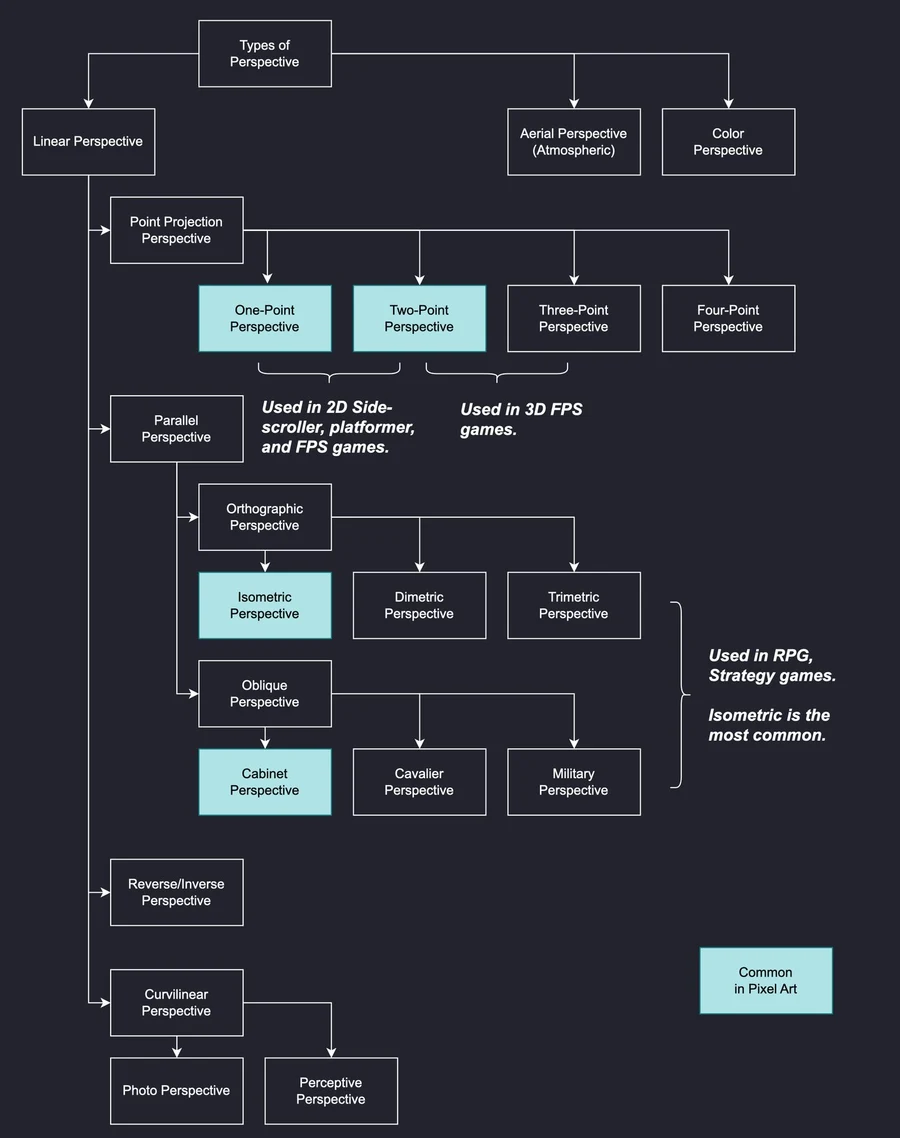
Why pixel ratios matter
In pixel art a line is a staircase of pixels. Some angles give a clean, even staircase: 1:1 is 45 degrees, 2:1 is about 26 degrees, 3:1 is flatter still. Other angles give uneven steps, and the line looks jagged. That's why pixel art bends the theory: isometric should be 30 degrees, and we draw it at 26, because 2:1 is clean.
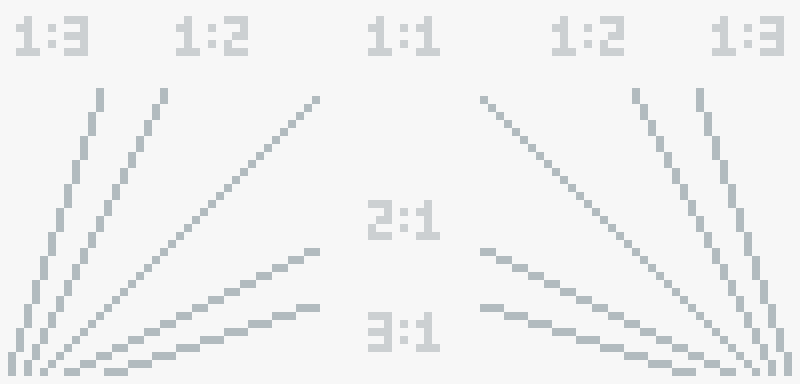
Linear perspective: vanishing points
The perspective from drawing class. Lines meet in vanishing points and things get smaller with distance. One-point and two-point are used in 2D side-scrollers, platformers and FPS games. Three-point and four-point belong to 3D FPS games.
One-point perspective
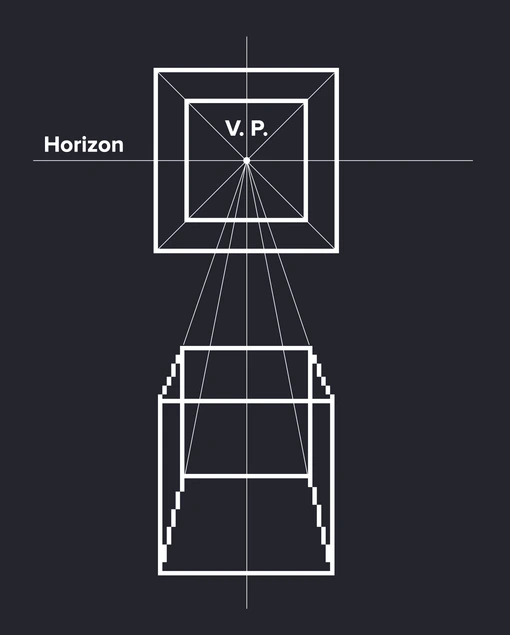
- All vertical lines are strictly vertical.
- All vanishing lines converge into one vanishing point.
- The front plane of the cube has no distortion.
- Horizontal lines perpendicular to the line of sight stay strictly horizontal.
- You see one or two planes of a cube.
Two-point perspective
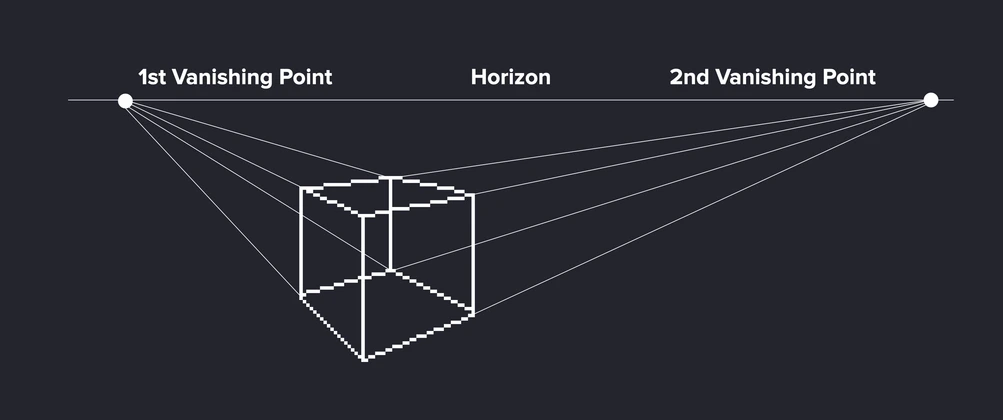
- All vertical lines are strictly vertical.
- All vanishing lines converge into two vanishing points on the horizon.
- You see two or three planes of a cube.
Three-point perspective
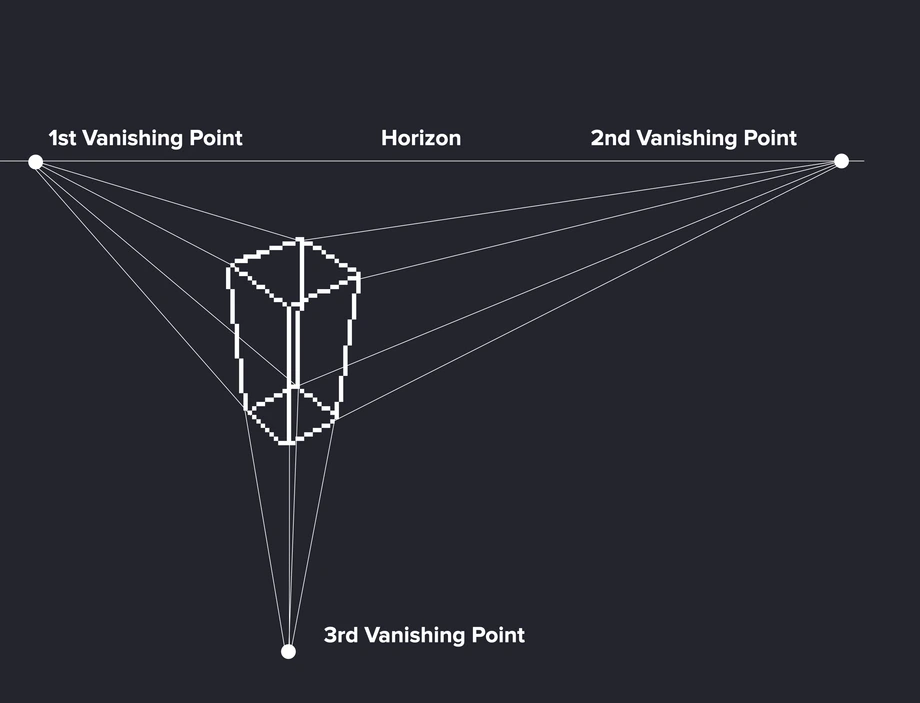
- Used for objects far above or below the horizon.
- The vanishing lines converge into three vanishing points.
- You see three planes of a cube.
Four-point perspective
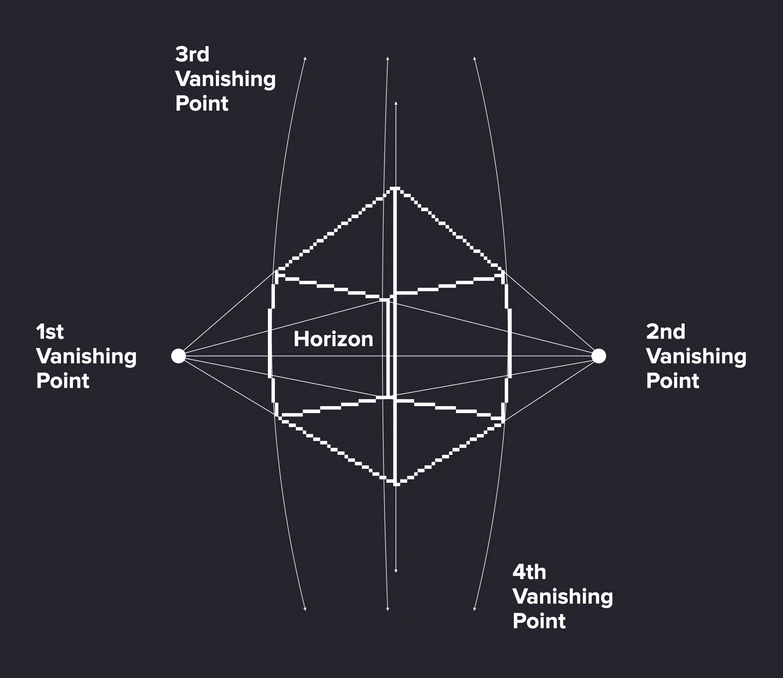
- All horizontal lines are straight and converge into two vanishing points on the horizon.
- All vertical lines are curved and converge into two points, one far above and one far below.
- You see two side planes of a cube.
Parallel perspective: isometric, dimetric, trimetric
No vanishing points: lines that are parallel on the object stay parallel on screen, and nothing shrinks with distance. Used in RPG and strategy games, and isometric is the most common of all: a sprite looks the same anywhere on the map.
Isometric perspective
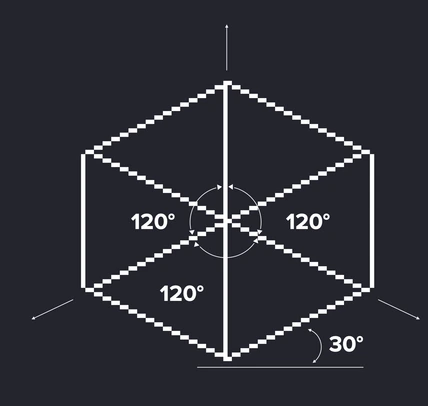
- All edges have the same length.
- All sides have the same area.
- Foreshortening is about 80%.
- The x axis is 30 degrees in theory, but in pixel art it is about 26 degrees: the clean 2:1 line.
- Apart from games and pixel art, isometric is used in technical drawings.
Dimetric perspective
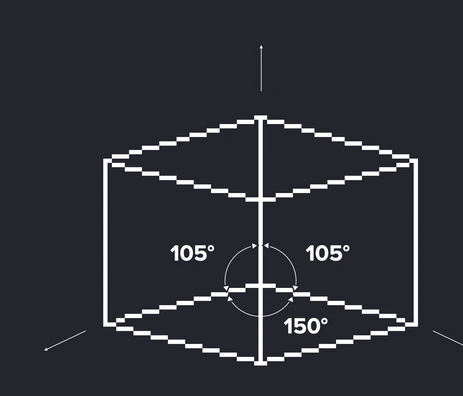
- Two axes have the same foreshortening, the third is foreshortened more.
- All vertical lines are strictly vertical.
- The vanishing lines are parallel to each other.
Trimetric perspective
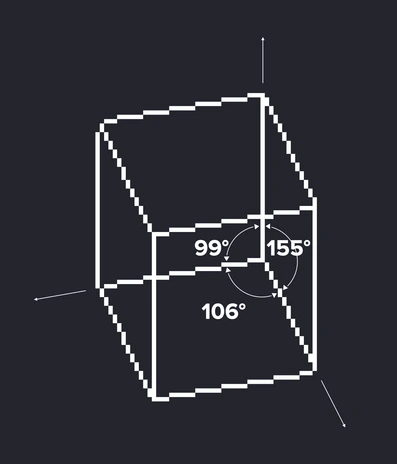
- All three axes have a different foreshortening.
- All vertical edges are strictly vertical.
- The vanishing lines are parallel to each other.
Strictly speaking, the 2:1 pixel version is a kind of dimetric projection, but everyone in pixel art calls it isometric, and so do I. You can see it in my air conditioner andvending machine lessons.
Oblique perspective: cabinet, cavalier, military
One face of the object stays flat and undistorted, and depth goes at 45 degrees: a clean 1:1 staircase. The easiest perspective to draw. Side view games use it for furniture and buildings, top down layouts use military.
Cabinet perspective
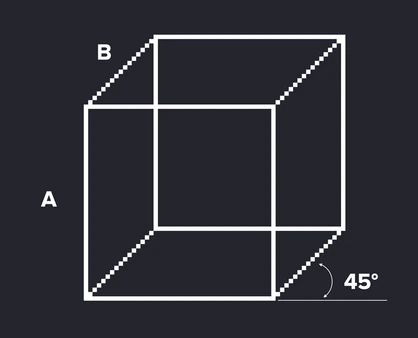
- Often used in furniture drawing.
- The front and back planes are undistorted.
- The top and side planes are foreshortened to 50%.
- All vanishing lines are parallel and tilted at 45 degrees.
- All vertical lines are strictly vertical.
Cavalier perspective
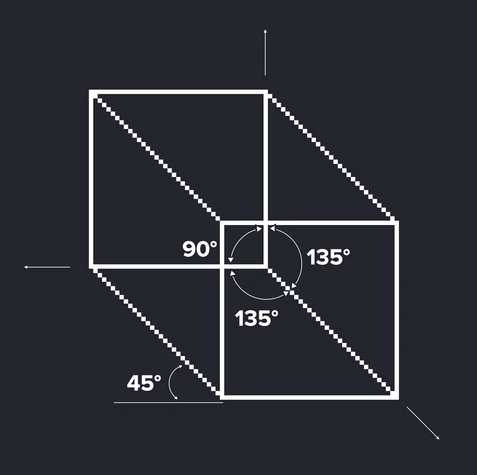
- The front and back planes are undistorted and drawn as squares.
- All edges of the cube are equal in size.
- All vanishing lines are parallel, at a 45 degree angle.
Military perspective
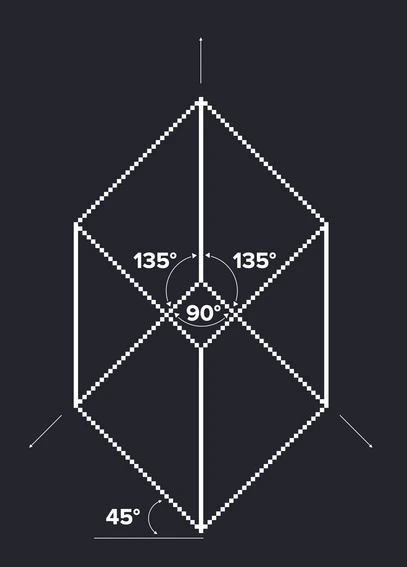
- Used for military fortification drawings, hence the name.
- The top and bottom planes are undistorted.
- All edges of the cube are equal in size.
- All vanishing lines are parallel, at a 45 degree angle.
Reverse and curvilinear perspective
Good to know, rare in games.
Reverse perspective
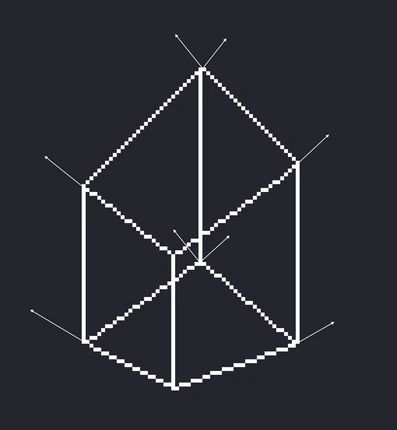
- Some or all vanishing lines diverge instead of converging.
- All lines are straight.
- All vertical lines are strictly vertical.
Very unlikely in pixel art: other perspectives do the job better.
Photo perspective
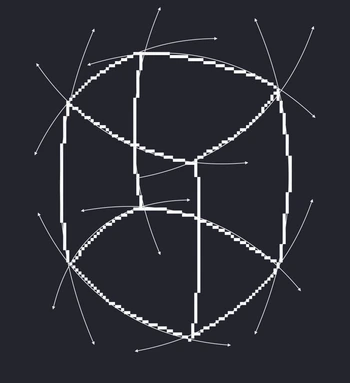
- Comes with photo lens distortion, like a fish-eye.
- All edges are curved.
- All planes are distorted.
It makes objects look bloated. Rare in pixel art.
Perceptive perspective
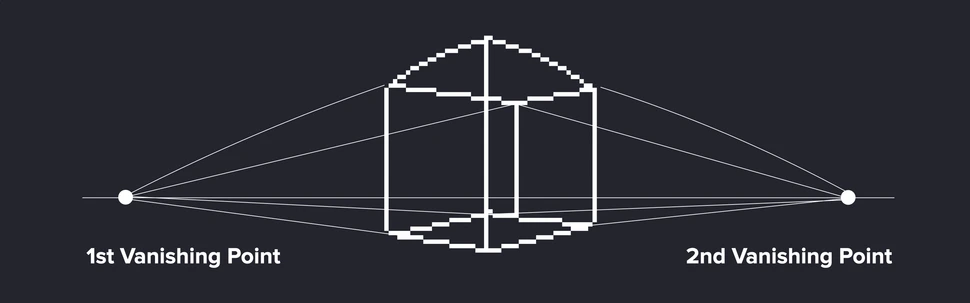
- Can be used for interior drawings.
- All vertical edges are strictly vertical.
- All, or some, vanishing lines are curved.
Aerial and color perspective
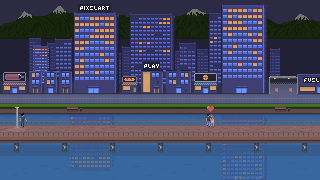
- Far away objects look smaller, hazier, paler or darker, and bluer.
- Background objects are drawn more laconic: fewer details. The near windows have lights and several shades, the far ones become thin lines.
Quick comparison
| Perspective | Depth lines in pixels | What you see | Good for |
|---|---|---|---|
| Isometric | 2:1, about 26° | Top and two sides equally | Strategy, city builders, rooms |
| Dimetric | 3:1, 4:1 and similar | More top or more front | Isometric style with a different tilt |
| Cabinet | 1:1, depth at half length | A flat front plus a short side | Side view props and buildings |
| Cavalier | 1:1, depth at full length | A flat front plus a long side | Technical, blocky looks |
| Military | 1:1, top undistorted | A flat floor plan plus walls | Maps and top down layouts |
| One and two point | Lines meet in vanishing points | A front, or a corner | Side-scrollers, platformers, FPS |
| Three and four point | Lines meet in 3 or 4 points | Looking up, down, or very wide | 3D FPS games |
How to choose
- Do players need to see every side of things? Isometric.
- Is the game in side view? Cabinet oblique for props, flat fronts for everything else.
- Does the floor plan need to stay readable? Military or a straight top down view.
- Is it a side-scroller, platformer or first-person scene? One or two point perspective.
Whatever you pick, use it for every object in the game. One table in cabinet next to another in isometric is the most common perspective mistake I see in student work, and the eye notices it right away. If you work from a reference, check that its view matches yours before you start.